Service Virtualization as Configuration
Most QA organizations still treat service virtualization as an environment configured through a UI. That model does not survive modern software delivery. If a virtualized dependency can change without a pull request, your team loses the process trail. Nobody reviews the behavior change, no commit links to tracking the requirements, and no build record shows which version was tested. Your team is left trusting whatever is saved in the editor and scratching their heads when a test passes or fails unexpectedly.
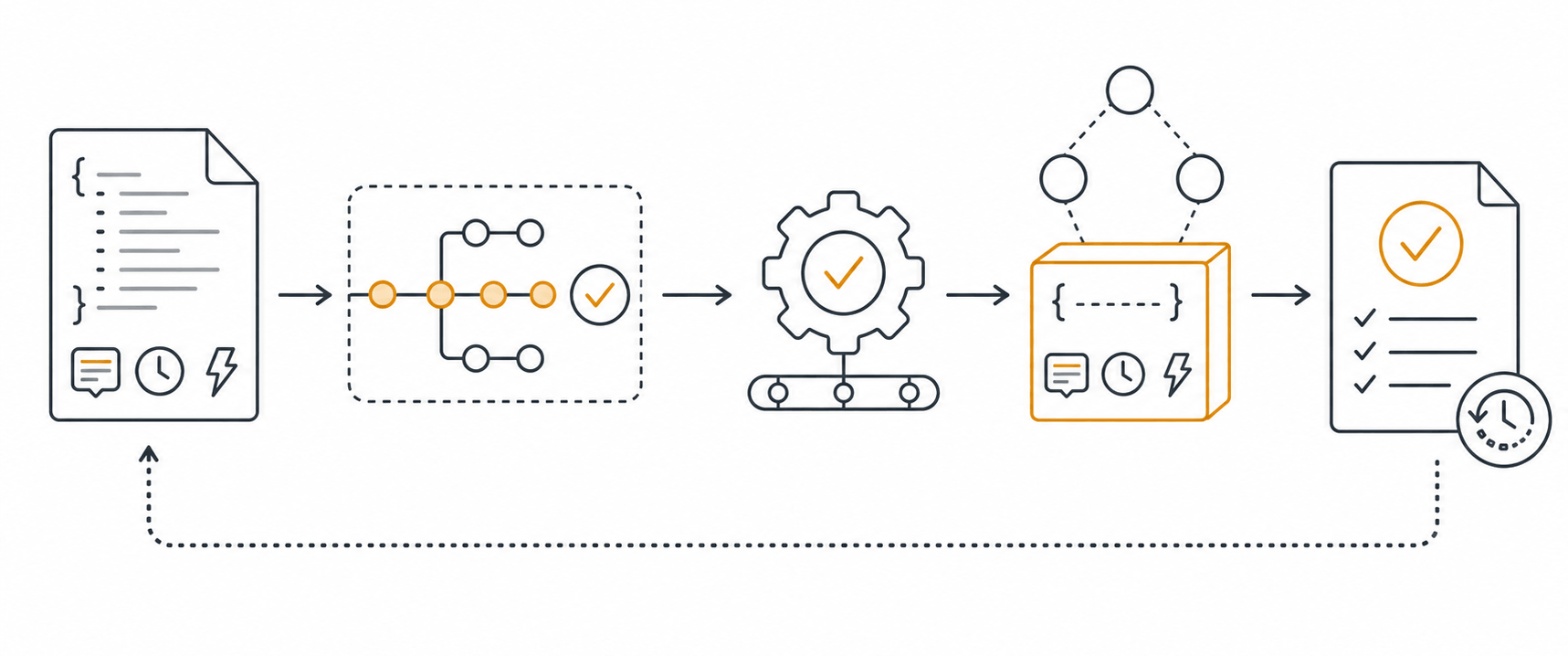
The better model is configuration-driven simulation. You define request matching, responses, faults, state, and latency in JSON or another readable specification. You keep that behavior beside your test code in Git, review both in the same pull request, and apply them through the same pipeline.
Dependencies as Code
Development and production environments once faced similar challenge - until Infrastructure as Code (IaC) transformed how their teams manage infrastructure. Today, your operations teams rely on IaC for consistent & repeatable infrastructure. What used to be a series of tickets and console clicks is now a set of declarative files that can be peer-reviewed, validated, applied, and reverted as needed. The same discipline and traceability that IaC brings to infrastructure should be applied to your simulated dependencies, treat their behavior and configuration as code.
Consider a checkout scenario: when this request arrives with a premium customer ID, return a specific response after 800 milliseconds. On the third attempt, update a counter and return HTTP 429. That scenario is both data and behavior. It belongs in Git just as much as a Terraform module or Kubernetes manifest does.
The parallel with IaC goes further than simply exporting a file:
| IaC practice | Service virtualization equivalent |
|---|---|
| Desired state | Matchers, responses, faults, latency, and state transitions |
| Plan and review | Schema validation and a readable pull request diff |
| Apply | Replace or deploy the complete behavior set |
| Ephemeral environment | A virtual service for each branch, build, or test suite |
| Drift control | Reapply the Git version before your tests run |
| Destroy or reset | Clear counters, test data, and scenario state |
Configuration gives you repeatability. Once your team works this way, the benefits are practical rather than theoretical:
- Your functional, integration, and performance tests become repeatable
- Each branch can carry its own contracts and dependency behavior
- Your pipeline can answer, "What exactly did this build test against?"
- Teams stop competing for the same unstable test environment
- You reduce third-party calls and keep synthetic test data under control
- A bad behavior change can be reviewed and rolled back like any other code change
Even a meaningful behavior change can stay small enough for you can review in a few seconds:
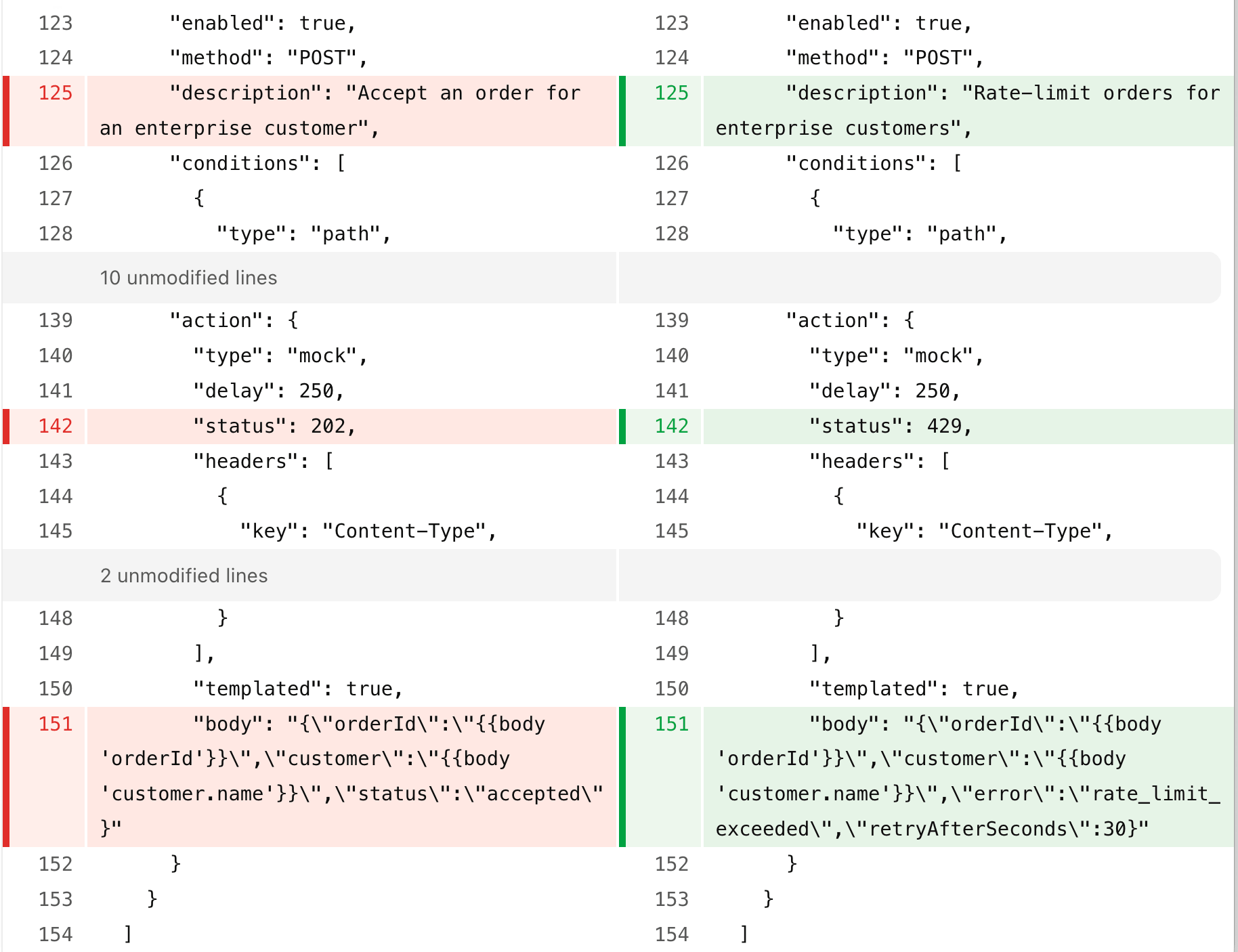
It also gives AI something traditional visual models rarely provide: a constrained, machine-readable control surface.
From Git to an AI-operated SDLC
When your virtual services are declarative, an assistant does not need to click through a visual tool or invent behavior in a chat session. It can translate the intent into a configuration. Your CI pipeline validates and applies that change, and the requests captured during testing become evidence for the next change.
- As an author, it translates "return 429 after repeated checkout attempts" into declarative rules
- As a verifier, it checks schemas, finds overlapping matchers, compares simulations with contracts, and proposes missing negative cases
- As an operator, it resets state, updates behavior, or inspects requests while your team debugs a failed test
Your configuration should always be the source of truth. Prompts describe what you want, but your committed behaviors document what is actually tested. This clear separation lets AI help without making your process confusing.
When comparing service virtualization tools, you should go beyond protocol checklists and ask:
- Can your team understand and review behavior changes in code review?
- Can CI reliably set up and reset mocks as code?
- Can AI generate and update rules without sidestepping version control?
Service Virtualization: Platform Approaches
Nearly every tool advertises CI/CD compatibility, but dividing solutions into "as code" and "not as code" oversimplifies the landscape. Tools like Parasoft Virtualize and Broadcom DevTest do support storing assets in Git and integrating with pipelines. The key distinction is whether your team or AI interacts with clear, reviewable configuration files, or must work through bulky, tool-generated serializations with low signal-to-noise for behavior changes.
| Tool | Format | Capabilities |
|---|---|---|
| Beeceptor | JSON rules, API specs |
|
| WireMock | JSON mappings, Java code |
|
| Microcks | API specs, custom scripts |
|
| Parasoft Virtualize | PVA XML, environment and data files |
|
| Broadcom DevTest | VSM XML, VSI XML, MAR, request-response pairs |
|
How a tool achieves "service virtualization as code" also matters. For example, calling a .pva, .vsm, or .vsi file code is technically defensible because Git can store it. That is only half the job. Your QA engineers still need semantic diffs that they and their reviewers can understand. Broadcom's Java SV-as-Code layer improves automation around its assets, but it is not the same design as a concise declarative behavior file.
The most important goal should be traceability on what changed.
Beeceptor Example
The operating model becomes easier to judge when you can see the behavior file itself. Here is a Beeceptor bulk-replacement payload that you can keep beside its tests and apply through the management API or CLI:
{
  "rules": [
    {
      "enabled": true,
      "method": "GET",
      "description": "Return a generated customer",
      "conditions": [
        {
          "type": "path",
          "operator": "equals",
          "value": "/customers/random"
        }
      ],
      "action": {
        "type": "mock",
        "delay": 100,
        "status": 200,
        "headers": [
          {
            "key": "Content-Type",
            "value": "application/json",
            "templated": false
          }
        ],
        "templated": true,
        "body": "{\"id\":\"{{faker 'string.uuid'}}\",\"name\":\"{{faker 'person.fullName'}}\",\"email\":\"{{faker 'internet.email'}}\"}"
      }
    },
    {
      "enabled": true,
      "method": "POST",
      "description": "Accept an order for an enterprise customer",
      "conditions": [
        {
          "type": "path",
          "operator": "equals",
          "value": "/orders"
        },
        {
          "type": "body_param",
          "key": "customer.tier",
          "operator": "equals",
          "value": "enterprise"
        }
      ],
      "action": {
        "type": "mock",
        "delay": 250,
        "status": 202,
        "headers": [
          {
            "key": "Content-Type",
            "value": "application/json",
            "templated": false
          }
        ],
        "templated": true,
        "body": "{\"orderId\":\"{{body 'orderId'}}\",\"customer\":\"{{body 'customer.name'}}\",\"status\":\"accepted\"}"
      }
    }
  ]
}
The first rule returns a generated customer. The second has two conditions, path and customer tier, then reads orderId and customer.name from the request body to build its response. This is easy to review. The pipeline can apply this file through the bulk rules API before tests begin. Beeceptor evaluates rules from top to bottom, so priority also a reviewable item.
Summary
Configuration-driven simulation turns dependency behavior into a normal delivery asset. The outcome is not simply more virtual services. Your teams gain governed independence: fewer blockers, more deterministic builds, cheaper performance testing, safer synthetic data, and an audit trail for every simulated decision.
When contracts, tests, and dependency behavior evolve in one pull request, you close one of the SDLC's most stubborn gaps. You can describe the world its software depends on, review it, reproduce it, and improve it. The AI makes that loop further faster. The real win is simpler: your dependency behavior finally follows the same engineering discipline as your application and infrastructure code!