Testing Without Waiting: A Practical Guide to Service Virtualization
As applications grow, testing becomes less about validating code and more about managing dependencies.
Consider this example, where a single user transaction may touch authentication providers, payment gateways, inventory systems, fraud detection services, message queues, email, SMS, partner APIs, and internal microservices. While development teams can move quickly inside their own codebase, they often have little control over the systems their application depends on. They work on one assumption, 100% availability of these systems.
This is where large-scale testing starts to break down.
A payment provider may have rate limits. A third-party API may charge per request. A staging environment may be shared across multiple teams. A microservice owned by another team may still be under development. In many organizations, these external dependencies become the biggest obstacle to continuous testing.
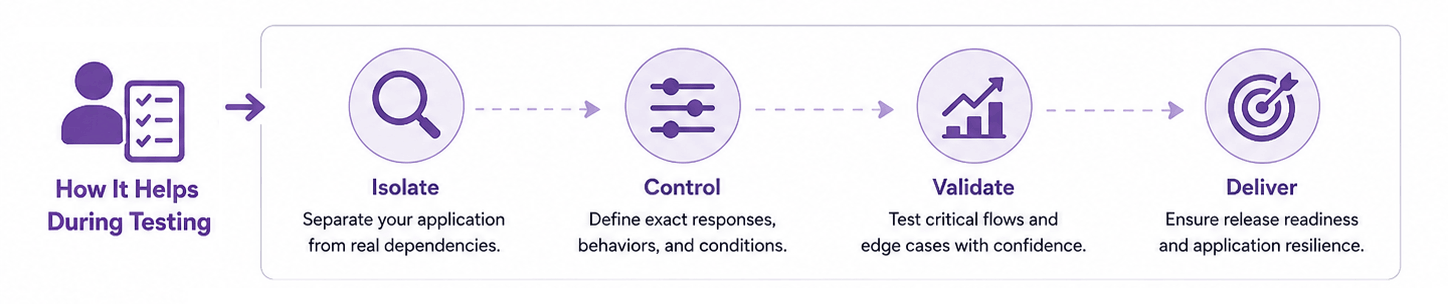
Service Virtualization solves this problem by giving teams a controllable version of those dependencies. Instead of waiting for systems to become available, engineering teams can simulate their behavior and continue development, integration, automation, and performance testing without interruption.
Dependency Bottlenecks - A Hidden Cost
Most of the testing delays are not caused by the application under test, or people. They're caused by the systems around it. Today's QA team don't have control over the end to end stack.
Consider a team building a checkout workflow. The checkout service may be complete, but testing cannot proceed because the payment provider is unavailable. Even when the provider becomes available, QA and SDET engineers may be limited to a small number of transactions, specific testing windows, or predefined test accounts. The more the services, the bigger the problem.
These constraints create a chain reaction. Test execution slows down. Automation coverage shrinks. Defects are discovered later in the release cycle. Teams spend more time coordinating environments than validating software. Service virtualization removes these bottlenecks by replacing constrained systems with virtual services that are available on demand. Development and testing no longer depend on external schedules, shared environments, or vendor availability.
Parallel Development
Microservices gives abstraction for a software stack (as well as an organization) to scale. They are supposed to make teams independent. However, in reality, they often introduce new dependencies between teams.
Imagine a mobile team building a customer onboarding experience while another team develops identity verification APIs. The frontend team cannot complete integration testing until the backend APIs are finished. The backend team cannot fully validate responses because the frontend is still evolving.
Without virtualization, both teams are blocked by each other's progress.
With virtual services, teams can work against API contracts instead of waiting for implementations. The APi contracts becomes the glue and lubricant that makes teams work without friction or dependency. For example, the onboarding workflow can be tested against realistic identity verification responses months before the production service is deployed.
This approach shifts testing left. The integration issues surface earlier, feedback loops become shorter, and teams spend less time resolving last-minute surprises during system testing.
Testing Negative Scenarios
Production incidents rarely happen because everything worked correctly. The applications fail when dependencies become slow, unavailable, inconsistent, or overloaded. Unfortunately, most of the QA teams, do the happy path testing, and the real world scenarios are hardest to reproduce using real systems.
You cannot easily ask a payment provider to return timeout errors for the next hour. You cannot instruct an authentication service to randomly fail every tenth request. You cannot safely shut down critical infrastructure just to validate failover behavior. Service virtualization gives you a complete control over dependency behavior.
Teams can simulate:
- Gateway timeouts
- Slow responses and network latency
- Authentication failures
- Rate limiting
- Invalid payloads
- Service outages
- Retry and fallback scenarios
These conditions can be triggered repeatedly and consistently across every test execution.
As a result, resilience testing becomes part of everyday development instead of a specialized exercise performed shortly before release.
Controlling Dependency Behavior
One of the biggest challenges in integration testing is that real dependencies rarely behave the way you need them to. External APIs, databases, payment gateways, and internal services are typically optimized for production workloads, not for testing specific edge cases.
For example, you need an API to suddenly take 10 seconds to respond, for a test scenario. You want a payment provider to return intermittent failures for 10% of times. Service virtualization lets you define exactly how dependent services behave. Instead of accepting whatever response a dependency happens to return, you can configure virtual services to respond with specific payloads, latency patterns, errors, or system states whenever needed.
This level of control is particularly useful when validating release readiness. For example, you can simulate:
- High-latency responses to verify whether critical user journeys continue to work when downstream services slow down.
- Timeouts, connection failures, and unexpected status codes to validate retry mechanisms and fallback logic.
- Fast responses and concurrent requests to uncover race conditions or synchronization issues that may not appear under normal loads.
- Different dependency states, such as missing records, expired sessions, inventory shortages, or account restrictions.
- Security and resilience scenarios, including invalid tokens, authorization failures, malformed payloads, and service outages.
The result is a more predictable testing environment where QA engineers can validate both expected and unexpected behavior before software reaches production.
Data Control
Large-scale testing requires large-scale data setup. Many times the QA engineers struggle with maintaining test databases, sanitizing production records, creating test data in 3rd party services, and coordinating test data across multiple micro-services. Even when data is available, creating specific business conditions often requires extensive setup and takes time.
A virtual service eliminate much of this complexity. Instead of depending on real systems, the Service virtualization platform can generate exactly the data needed for a test scenario. A customer can have five active subscriptions, twenty failed transactions, or a suspended account state without modifying a database or coordinating with another team.
Platforms like Beeceptor extend this further by generating dynamic responses from request components, creating realistic test records on demand, store state data to make meaning full API call chain, and producing unique payloads for every request. As an engineer, you can model thousands of business scenarios without maintaining thousands of test records. Such behaviors are managed as test config, not as code. This makes automated testing significantly easier to scale.
Stable CI/CD Pipelines
One unstable dependency can invalidate an entire automation pipeline. For example, a third-party API outage can cause hundreds of tests to fail. Shared environments can introduce inconsistent results. Rate limits can make test runs unpredictable. In many organizations, QA organization spend more time investigating environment issues than actual product defects. Now, on this day if you are tasked to signoff a release, you can't.
Service virtualization brings determinism back into automated testing, and gives you full control over what you are testing. Virtual services behave consistently across every build, every environment, and every pipeline execution. Response times, payloads, status codes, and error conditions remain under the team's control.
This consistency improves confidence, and allows engineering teams to run larger automation suites more frequently. Follow the CI/CD integration tutorial to apply version-controlled mock rules and reset state before each test run.
Do Not Replace Real Systems
Service virtualization is not about eliminating integration testing against real services. It is about reducing dependency risk throughout the software development lifecycle. Your team's productivity should not depend on external factors.
You still validate real integrations before release. The difference is that they no longer wait until the final stages of development to begin testing. When you need to test with real services, features like HTTP Proxy help you switch help to route traffic to real services in a single click.
For organizations building API-driven applications, service virtualization creates a practical path to continuous testing. It removes dependency bottlenecks, enables parallel development, improves test coverage, and gives teams complete control over the conditions under which software is validated.
As systems become increasingly distributed, that level of control becomes less of a convenience and more of a requirement for delivering software at scale.