Accelerating API Onboarding
An effective API program gives developers, vendors, and partners a short, predictable path from discovery to their first successful call. That first interaction builds confidence in the contract, validates the integration approach, and gives your team early feedback about the API experience.
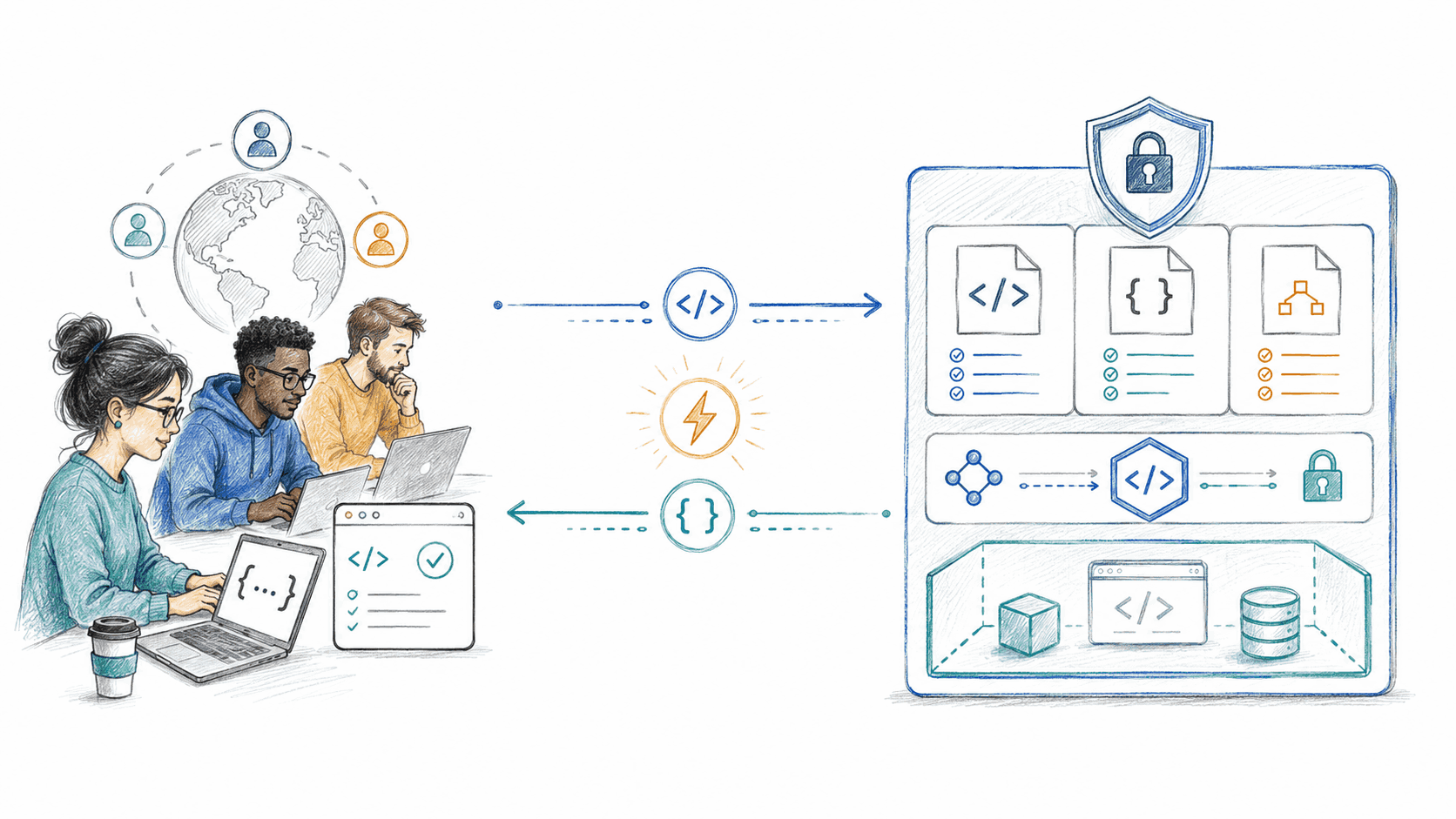
For enterprise and banking APIs, access to a real sandbox naturally takes longer. Legal review, security assessment, identity provisioning, data entitlements, and network changes may all be necessary. A virtual sandbox lets your consumers start building while those processes continue, reducing time to first call from weeks to minutes without relaxing any environment access controls.
This practical approach gives your API program the following benefits:
- External developers validate requests and responses before real-sandbox access
- Partner teams start SDK, UI, and workflow development earlier
- Fewer integration bugs, basic contract errors, and technical support queries
- QA gains a safe environment for success, failure, latency, and stateful scenarios
- AI-assisted development without credentials for the real sandbox
Onboarding Latency
API onboarding is often delayed by several independent processes. Documentation may be available on the first touch, while the API endpoint itself remains unreachable. Credentials may be approved, while a VPN route, private DNS entry, firewall rule, or test account is still pending. Even after connectivity is established, usable test data may not exist.
These delays are frequently grouped together as one onboarding process, which makes it difficult to see what is actually blocking the consumer.
| Dependency | Sandbox path |
|---|---|
| API contract | Immediately available and executable |
| Identity | Anonymous access or a low-risk sandbox credential |
| Network | Pre-enabled HTTPS endpoint or internal sandbox route |
| Data | Synthetic and controlled test records |
| Behavior | Designed scenarios and predictable failures |
The objective is not to bypass approvals. It is to apply approval where it adds value. Sandbox credentials, sensitive data, elevated permissions, and private network access should remain governed. Standard virtual-sandbox access can be pre-approved, automated, and auditable.
Parallel Access
A better onboarding flow separates the time to experiment from the time to reach real sandbox and then go-live.
Your consumer can discover the API, review its specification, obtain a sandbox URL, and make a representative call in the same working session. Legal, commercial, security, and sandbox-connectivity tasks proceed in parallel.
By the time sandbox access is approved, the client may already handle request construction, response parsing, pagination, errors, retries, and the main business workflow. The final transition becomes a controlled environment change instead of the beginning of development.
Sandbox Experience
As an API product, make the virtual sandbox part of your API experience. It should provide more than a route that returns 200 OK and a static payload.
A useful sandbox preserves the API's paths, operations, schemas, headers, and content types. It should include representative success and error responses, stable business records, observable request history, and enough state to complete meaningful workflows. In addition, the consumer's QA team should be able to simulate latency, faults, rate limits, authentication failures, unavailable inventory, or downstream errors.
When access to the real sandbox becomes available, the consumer changes the API's base URL and credentials. The integration is already written, and only validation against the real sandbox remains. This does not make a virtual sandbox a certification environment. It does ensure that both teams reach real-sandbox testing with fewer basic contract and client defects.
Contract-Driven Setup
Machine-readable API contracts make self-service sandboxes practical. Instead of manually implementing every route, your team can activate the contract as an executable service.
Beeceptor can create a REST mock server from an OpenAPI document in YAML or JSON. It can also build a GraphQL mock server from SDL or introspection. The same contract-first approach extends to WSDL for SOAP and Proto definitions for gRPC.
The specification establishes the paths, operations, types, and response structure. Your API and QA teams then add the behavior required for onboarding, including validation errors, authorization outcomes, delayed responses, state transitions, and business-specific conditions.
Contract quality matters. Meaningful field names, descriptions, formats, examples, and error schemas allow both people and automation to produce a better sandbox. A thin specification with generic strings may be machine-readable, but it still leaves too much business meaning undocumented.
This model also reduces maintenance. When the API contract changes, your team updates the specification and refreshes the sandbox rather than maintaining documentation and simulation as unrelated implementations.
Test Data Strategy
Once the virtual sandbox is set up, it is time to manage test data. Random data alone is unsuitable for structured onboarding. If the same tutorial returns unrelated customers, flights, balances, or orders on every call, examples become difficult to reproduce and support conversations lose context.
A reliable sandbox combines golden test data with realistic variation.
Golden data consists of stable, named records representing important business states. Depending on your domain, this could include an active customer, a suspended account, a flight with available seats, a cancellable booking, a rejected payment, or a shipment with a complete tracking history. These records make documentation examples, partner certification checks, support instructions, and automated tests repeatable.
Beeceptor's Intelligent Mocks and test-data mappings add realistic variation around that stable foundation. Beeceptor uses schema names, descriptions, and data types to produce contextual test data instead of generic placeholders such as "string" and 0. Your team can replace generators, constrain ranges, or assign fixed values to important fields.
For multi-call journeys, stateful mock data can preserve information between requests. A booking created in one call can be retrieved or cancelled in a later call. A registration can create a user that is subsequently returned by a profile endpoint.
This golden data adds value to integration demonstrations. Intelligent generation provides breadth. Stateful behavior connects individual calls into a credible workflow.
Amadeus Example
Beeceptor's ready-to-use virtual sandbox catalog demonstrates how quickly this model can shorten API onboarding. The catalog includes an Amadeus API virtual sandbox with operations covering locations, flight shopping, pricing, hotels, seat maps, booking workflows, and other travel scenarios.
A developer can configure the following base URL and begin exploring the API surface without first obtaining live credentials:
https://amadeus-api.mock.beeceptor.com
Consider a team building a corporate travel application. The frontend developers can search for destinations and flight offers, build pricing screens, and exercise booking-related request models. QA can work with stable itineraries, no-availability responses, invalid inputs, and delayed calls. The integration team can confirm how the application handles each response before the real-sandbox access process is complete.
Using the virtual sandbox does not certify the final Amadeus integration. Its value comes earlier. It helps the team establish the client, workflow, and error-handling behavior while access to the real dependency is still being arranged.
The same pattern applies to banks onboarding payment partners, logistics providers onboarding merchants, healthcare platforms integrating vendors, and internal platform teams publishing APIs to application developers.
Modern Virtualization
Traditional service virtualization platforms are valuable when an organization must reproduce complex legacy systems, mainframe transactions, specialized protocols, or deeply coupled enterprise workflows. They are less effective for onboarding because they are centralized and usually treated as internal tooling.
Modern tools such as Beeceptor make this API onboarding path lighter. An API or QA team can start from the contract, generate a working service, add business behavior, control test data, and provide a stable endpoint without building and operating another backend application. The distinction is important: the goal is not to model the entire target ecosystem before a developer makes a call. The goal is to virtualize enough of the contract, then add depth where the onboarding journey needs it.
AI Assistance
For an API consumer, AI is most valuable when it can interact with the virtual sandbox, not merely suggest client code. Beeceptor MCP connects MCP-enabled development tools to a Beeceptor endpoint through structured operations.
With authorized access, an AI coding agent can retrieve the sandbox URL, inspect configured behaviors, search request history, and examine the complete request received by the endpoint. It can use that evidence to correct a header, payload, path, or client configuration directly in the consumer's codebase.
For example, a developer can ask an agent to connect an SDK to the virtual sandbox, make a flight-search request, and verify what Beeceptor received. If the call does not match the expected behavior, the agent can compare the captured request with the configured rule and help correct the integration without requiring a support handoff.
Where permissions allow, the agent can also create a targeted error scenario, reset sandbox state, or prepare records needed for the next workflow. Beeceptor remains the execution engine, while OAuth authorization and endpoint permissions keep these operations controlled.
This gives API consumers a shorter feedback loop across client generation, sandbox execution, request inspection, and correction, without giving the agent credentials for the real sandbox or access to sensitive data.
Operational Measures
Portal registrations and documentation views show interest, but they do not show whether a consumer can integrate successfully. API leaders should measure progress through executable milestones:
- Time from registration to the first successful call
- Time to complete the first representative workflow
- Percentage of consumers reaching the first call without support
- Support requests per onboarded organization
- Contract errors found during virtual-sandbox use
- Virtual-to-real-sandbox transition success rate
- Consumer drop-off before the first successful call
Real-sandbox credential lead time should remain visible as a separate measure. This prevents an unavoidable legal or compliance review from hiding improvements made by the API, QA, platform, and developer-experience teams.
Sandbox Transition
A developer portal helps consumers discover an API. A virtual sandbox lets them experience it.
The strongest onboarding model combines machine-readable contracts, immediate virtual-sandbox access, golden test data, realistic generated responses, observable requests, and a controlled switch to the real sandbox. It preserves the required access controls while allowing useful technical work to start much earlier.
Your approval processes remain accountable. At the same time, developers, vendors, and partners can validate the integration, build confidence, and make meaningful progress from their first day.