Stop Third-Party Dependencies from Ruining Your Load Tests
Deterministic, Low-Overhead Service Virtualization for High-Load Testing
Request Benchmark ReportRemove the third-party API. Keep its behavior.
External sandboxes introduce throttling, outages, and latency variance. Replace them with fixed, repeatable test conditions.
Configure behavior
Set status codes, payloads, headers, dynamic responses, faults, and simulate latency profiles.
Repeat test conditions
Reuse the same dependency profile across builds and environments.
Measure capacity
Correlate p95, p99, throughput, CPU, and memory. Scale before saturation.
Keep dependency behavior beside your test code
Version control your simulation behaviors in GitHub. Define request matching, responses, faults, and delay in JSON. Review changes through the same performance-testing and development workflows.
{
  "id": "payments-dependency",
  "enabled": true,
  "method": "POST",
  "conditions": [
    {
      "type": "path",
      "operator": "equals",
      "value": "/v1/payments"
    }
  ],
  "action": {
    "type": "mock",
    "status": 200,
    "headers": [
      { "key": "Content-Type", "value": "application/json" }
    ],
    "body": "{\"status\":\"authorized\"}",
    "delay": 150
  }
}Model the tail and exercise the failure path
Define timing and failure behavior per route, then replay the same conditions across every load-test run.
Fixed and ranged latency
Hold responses at a fixed delay or define explicit timing ranges for slow dependencies.
Mixed latency profiles
Assign different delays across APIs to reproduce fast, slow, and timeout-prone dependencies in one profile.
Chaos and cyclic failures
Sequence intermittent errors and recovery responses to exercise retries, fallbacks, and circuit breakers.
Stateful multi-API simulations
Let read, write, and lookup APIs share stored data so workflow state remains consistent across calls.
Gateway timeout
Put deterministic simulation behind the system under test
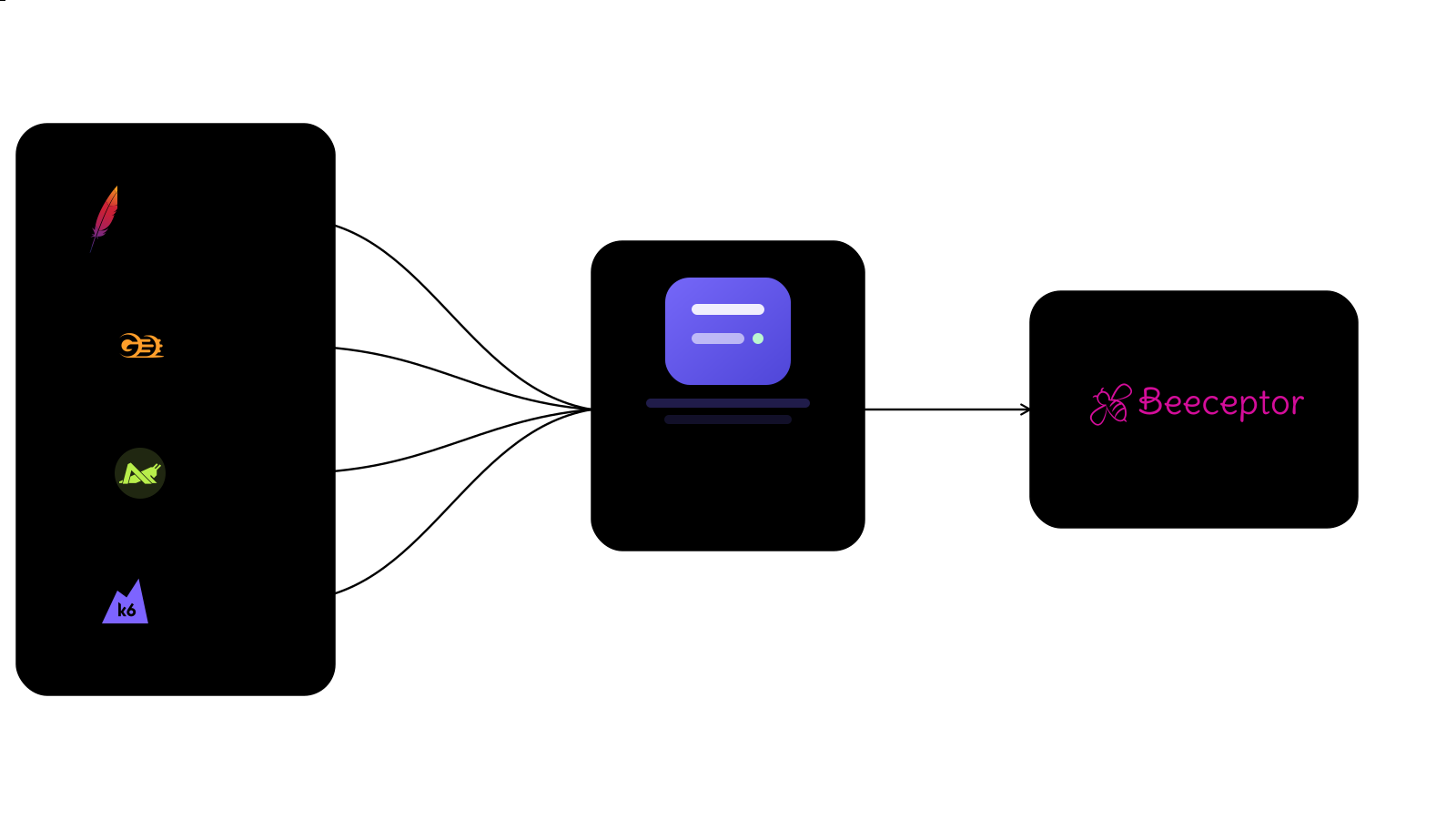
Drive load with k6, JMeter, Gatling, or Locust while Beeceptor controls downstream API timing, payloads, and failures.
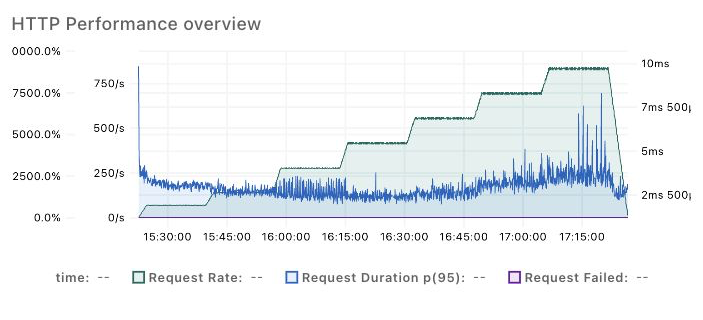
Baseline, scale, and endurance
The benchmark report covers 11 deterministic tests across static and dynamic responses, 10–100 KB payloads, fixed and mixed delays, horizontal scale, and an eight-hour soak.
Low latency that stays low
Across static and dynamic responses, 10–100 KB payloads, and configured delays from milliseconds to seconds, Beeceptor preserved repeatable behavior throughout the validated capacity range.
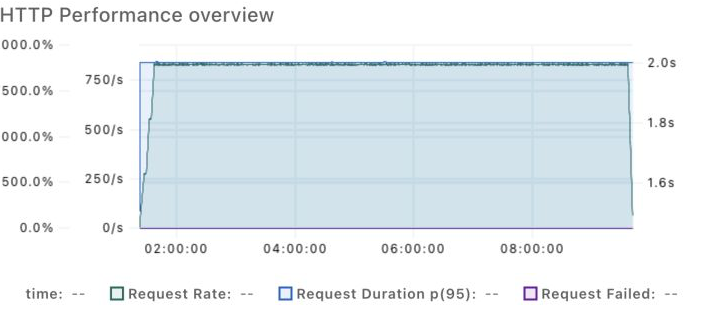
Eight hours. No upward creep.
During the eight-hour soak, Beeceptor maintained configured behavior without throughput erosion or response-time drift.
Vertical or horizontal scale. The simulation stays deterministic.
Beeceptor supports both vertical and horizontal scaling, with customized deployments for your workload, concurrency, and infrastructure requirements.
Bring your own observability stack. Find the source of every slowdown.
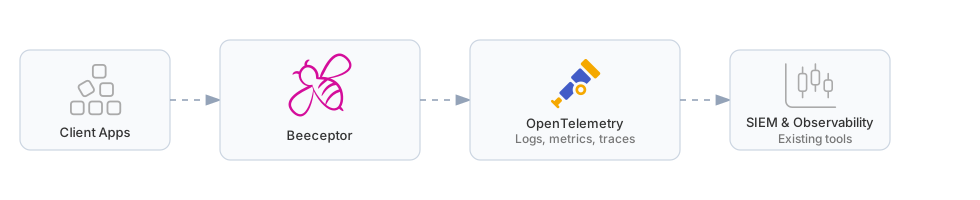
Export simulation traffic, traces, logs, and metrics through OpenTelemetry into the tools your performance team already uses. Correlate throughput with route behavior, tail latency, failures, and infrastructure headroom.
Scale virtual services without scaling operational complexity.
Enterprise service-virtualization platforms are capable, but their deployment, licensing, and tuning models can add infrastructure and operational work.
Production guidance spans three server roles
Parasoft's production guidance recommends separate CTP, staging Virtualize, and production Virtualize servers, with additional instances for performance isolation, scale, or failover.
Beeceptor: Run a shared simulation stack and add instances as load grows.
Performance testing requires a performance VSE
Broadcom documents a 10 TPS cap for a functional VSE. Higher-throughput workloads require a performance VSE, along with performance-specific logging and runtime configuration.
Beeceptor: Use the same simulation workflow for functional and performance testing.
Self-host it. Standardize it.
Give performance, QA, development, and platform teams shared, deterministic simulations inside your network—with the same behavior from a laptop check to a sustained load test.