We ship fast!

We hold ourselves to the same standard we build Beeceptor for: remove blockers, move faster, and keep improving the system underneath. We ship continuously, with meaningful product updates landing every week.
This page highlights the major releases. Behind them is a steady stream of fixes, performance work, reliability improvements, and infrastructure upgrades that make Beeceptor stronger as your usage grows.
Got a feature request?Share it.
If it removes real friction, it gets our attention.
Real-World Latency Profiles
Beeceptor now lets you apply latency behavior across an entire virtual server. Use a fixed delay, random range, log-normal distribution, or load-based latency that increases as traffic grows.
This gives QA and performance engineers a practical way to test timeouts, retries, fallback paths, and degraded dependency behavior without adding delays to every mock rule.
You can still override latency at the rule level for specific test scenarios.
This gives QA and performance engineers a practical way to test timeouts, retries, fallback paths, and degraded dependency behavior without adding delays to every mock rule.
You can still override latency at the rule level for specific test scenarios.
Performance Benchmarking for Service Virtualization
At Beeceptor, we recently completed comprehensive performance benchmarking across static, dynamic, delayed, and mixed virtual API scenarios. These tests passed through sustained traffic stages up to 6 million transactions per hour (~1,667 requests per second) while showcasing predictable latency and stable behavior.
Configured response delays remained deterministic throughout the tests. Client-side measurements recorded p95 latency as low as 3.10 ms. Comparisons across static and dynamic responses, multiple virtual APIs, mixed request modes, payload sizes ranging from 10 KB to 100 KB, and intentionally induced latency all performed consistently within the planned capacity and expectations.
When horizontally scaled, Beeceptor sustained the most demanding workload with 0% HTTP request failures, while p95 latency remained closely aligned with the maximum configured response delay. This predictable behavior after adding capacity validates Beeceptor’s scale-out architecture. Built on Node.js and asynchronous I/O, Beeceptor is designed to handle highly concurrent virtual API traffic as deployments grow. Application-host metrics, including CPU and memory utilization, were tracked throughout the benchmark to correlate platform performance with infrastructure capacity.
These results reinforce our confidence in Beeceptor as an enterprise-ready service virtualization platform for reliable, repeatable performance testing.
Contact the Beeceptor support team to request access to the complete benchmarking report.
Configured response delays remained deterministic throughout the tests. Client-side measurements recorded p95 latency as low as 3.10 ms. Comparisons across static and dynamic responses, multiple virtual APIs, mixed request modes, payload sizes ranging from 10 KB to 100 KB, and intentionally induced latency all performed consistently within the planned capacity and expectations.
When horizontally scaled, Beeceptor sustained the most demanding workload with 0% HTTP request failures, while p95 latency remained closely aligned with the maximum configured response delay. This predictable behavior after adding capacity validates Beeceptor’s scale-out architecture. Built on Node.js and asynchronous I/O, Beeceptor is designed to handle highly concurrent virtual API traffic as deployments grow. Application-host metrics, including CPU and memory utilization, were tracked throughout the benchmark to correlate platform performance with infrastructure capacity.
These results reinforce our confidence in Beeceptor as an enterprise-ready service virtualization platform for reliable, repeatable performance testing.
Contact the Beeceptor support team to request access to the complete benchmarking report.
Custom Responses for Unmatched Requests
Beeceptor now lets you configure the default response for unmatched requests. This is useful when you want unknown API paths to fail explicitly instead of receiving the default
For example, you can configure an endpoint to return
How this works:
200 OK response.For example, you can configure an endpoint to return
501 Not Implemented whenever a request does not match any Mock Rule or OpenAPI route.How this works:
- Mock Rules continue to take highest priority.
- Requests matching your OpenAPI specification still receive generated mock responses.
- Requests that match neither will return your configured fallback response (such as 501 Not Implemented).
Client-specific mock behavior with mTLS
Beeceptor can now return different mock responses based on the identity of an mTLS-connected client. The client certificate subject is available in
Use it to simulate client-specific permissions, payloads, or error responses from a single endpoint, for example, one behavior for an authenticated partner and another for an internal service.
x-beeceptor-mtls-subject, which you can use as a request-header condition in a mock rule.Use it to simulate client-specific permissions, payloads, or error responses from a single endpoint, for example, one behavior for an authenticated partner and another for an internal service.
Simulate Delivery Dates, Retry Windows, and Expiry Logic
You can now parse dates, shift time forward or backward, and calculate date differences directly inside templates using
This makes it much easier to build realistic workflows without hardcoded timestamps.
For example:
dateParse, dateAdd, and dateDiff.This makes it much easier to build realistic workflows without hardcoded timestamps.
For example:
- Simulate an e-comm API that automatically returns a delivery date 3 days after checkout.
- Generate subscription renewal dates 30 days from signup.
- Calculate SLA breach duration between ticket creation and resolution.
- Test expiry windows, retry delays, OTP validity, or scheduled events dynamically.
- Your mocks can now behave closer to real production systems, especially for time-sensitive scenarios and automation testing.
Turn On Agentic Mode with Beeceptor MCP
Beeceptor introduces Agentic Mode with MCP (Model Context Protocol) support, bringing AI-driven control directly into your development workflow. Install the Beeceptor MCP tool in Cursor, Claude, Antigravity, or any MCP-compatible environment and let your AI assistant automatically interact and build mock behaviors.
You can now control your endpoints using simple natural language instructions directly from your working context. Create, update, and manage mock behaviors without switching tools or writing manual configurations.
With Agentic Mode, you can:
You can now control your endpoints using simple natural language instructions directly from your working context. Create, update, and manage mock behaviors without switching tools or writing manual configurations.
With Agentic Mode, you can:
- Create and modify mock behaviors from plain text instructions.
- Record API traffic, inspect requests, and generate mocks instantly.
- Build full prototypes with working backends using CRUD APIs, stateful scenarios, and user journeys.
- Generate dynamic responses using Beeceptor’s template engine.
- Test OAuth flows and authentication scenarios.
- Host and work with API specifications.
- Apply bulk updates across mock rules with a single instruction
Stronger Data Isolation for Enterprise
We’ve enhanced Beeceptor’s enterprise offering with stronger data isolation controls to better protect your organization’s data in Beeceptor Cloud. This builds on our existing safeguards and improves separation across customer environments.
Available for new enterprise accounts, this update reinforces our commitment to higher security while keeping your experience unchanged.
Available for new enterprise accounts, this update reinforces our commitment to higher security while keeping your experience unchanged.
Signup and Login With Email OTP
Beeceptor already supports SSO with Google, GitHub, and Azure. Now, you can use OTP for signup and login, so you don’t need to rely on passwords.
You can also enable “Restricted Mode” to disable password logins entirely and allow only OTP or SSO.
You can also enable “Restricted Mode” to disable password logins entirely and allow only OTP or SSO.
AI-Powered OpenAPI Contract Drift Detection (Beta)
API implementations evolve constantly, but OpenAPI specifications often fall behind. Your developers keep adding endpoints, modify responses, or change payload structures, while the contract documentation stays outdated. This contract drift can break API clients, invalidate mocks, and cause confusion across development and QA teams.
Beeceptor continuously monitors your APIs to keep your contract accurate. After you upload an OpenAPI specification, Beeceptor records real API traffic and validates every request and response against the spec. When a mismatch appears, Beeceptor flags it as contract drift and shows the exact difference.
Beeceptor AI then generates a smart patch based on the observed traffic. Review it and apply the update to your OpenAPI spec with a single click.
Detection, patching, and commit happen in seconds, saving hours of manual contract maintenance.
Beeceptor continuously monitors your APIs to keep your contract accurate. After you upload an OpenAPI specification, Beeceptor records real API traffic and validates every request and response against the spec. When a mismatch appears, Beeceptor flags it as contract drift and shows the exact difference.
Beeceptor AI then generates a smart patch based on the observed traffic. Review it and apply the update to your OpenAPI spec with a single click.
Detection, patching, and commit happen in seconds, saving hours of manual contract maintenance.
OpenAPI Specs: Override AI-Generated API Responses
Our OpenAPI-to-Mock capability already lets you go from an API specification to a live mock server in under a minute. You upload an OpenAPI spec and instantly see your API come to life with realistic, contextual responses. Instead of static placeholders, Beeceptor automatically generates meaningful test data - product names, people names, ages, street addresses, SSN/Aadhaar numbers, and more - using AI and 300+ built-in data generators. You get a mock API that looks and behaves much closer to a real production system.
Now we’re taking this a step further with custom response overrides.
While Beeceptor can automatically generate contextual responses, you can now override and customize any part of the generated response/field to match your exact testing needs. Want specific product names, controlled user profiles, or predictable IDs for integration tests? You’re in full control.
How: Switch to your endpoint settings and open Customize Test Data under the specification section.
No coding. No infrastructure. No deployments.
Just upload OpenAPI spec and start building.
Now we’re taking this a step further with custom response overrides.
While Beeceptor can automatically generate contextual responses, you can now override and customize any part of the generated response/field to match your exact testing needs. Want specific product names, controlled user profiles, or predictable IDs for integration tests? You’re in full control.
How: Switch to your endpoint settings and open Customize Test Data under the specification section.
No coding. No infrastructure. No deployments.
Just upload OpenAPI spec and start building.
Response Building: Fix errors with AI
If you run into syntax errors while building a dynamic response template for your mock rule, Fix with AI is here to help. Available directly from the error notification, it intelligently corrects the issue inline. Whether you’re working with JSON or XML, it focuses only on the relevant syntax errors, so you don’t have to spend time debugging formatting details.
You can stay focused, designing your mock APIs. It’s fast, context-aware, and built to save you time. Give it a try today
View Who’s Editing Mock Rules
Beeceptor now shows in real time who is actively editing a mock rule, so you always know what’s happening before making changes. If someone is working on a rule, now you can see it immediately, helping you avoid accidental overwrites and confusion. You can now confidently keep building and refining mocks without second guessing who’s editing what.
Easier 2FA Code Generation for Testing
We’ve made it much easier to bring your 2FA codes into Beeceptor. You can now simply drag-n-drop or paste image files, or even scan a QR code directly using your device camera if your QA code is on another device, making the experience faster and more seamless for sandbox and test authentication.
You can also generate a persistent link to retrieve future codes whenever you need them, so you don’t have to repeat the setup every time.
You can also generate a persistent link to retrieve future codes whenever you need them, so you don’t have to repeat the setup every time.
New UI Experience for Beeceptor
We’ve shipped brand-new user interface for Beeceptor! All the existing features remain the same, now presented in a cleaner and more intuitive design. The updated UI offers better contrast, and improved readability, making it easier to find what you need and work faster.
Alongside the visual update, we’ve rewritten the Rules Engine behind the scenes to deliver better performance and reliability.
This upgrade not just makes Beeceptor faster, easier to use, and eliable, but also helps us ship new features faster in the future. All these, without impacting your existing integrations.
Alongside the visual update, we’ve rewritten the Rules Engine behind the scenes to deliver better performance and reliability.
This upgrade not just makes Beeceptor faster, easier to use, and eliable, but also helps us ship new features faster in the future. All these, without impacting your existing integrations.
A Big Upgrade to How You Manage Rules
Managing more than ten rules is now smoother with an upgraded, stable interface.
- Search instantly across request path, rule ID, request body, and more for accurate filtering.
- Search results show high-quality matches and hide irrelevant ones.
- New or updated rules auto scroll into view with a highlight so you never lose track.
- Jump from request history directly to the matching rule with a single click.
- Reorder rule priority easily by dragging the leftmost icon.
Localized Test Data Generation
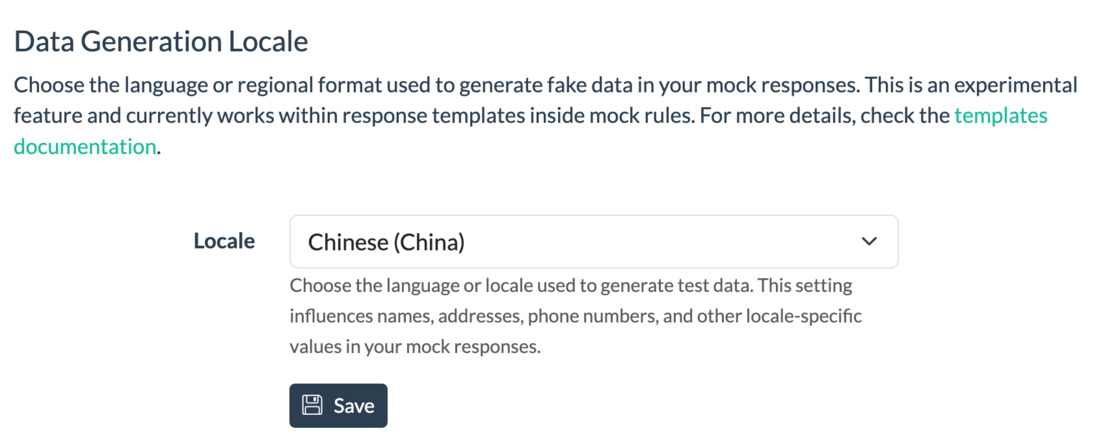
Beeceptor now supports localized test data for mock responses, enabling you for region-accurate demos.
You can set a preferred locale per endpoint, and Beeceptor will generate names, addresses, phone numbers, dates, and more based on that region. The synthetic data generation is supported in Portuguese, Spanish, English, French, Indonesian, or Chinese languages.
You can set a preferred locale per endpoint, and Beeceptor will generate names, addresses, phone numbers, dates, and more based on that region. The synthetic data generation is supported in Portuguese, Spanish, English, French, Indonesian, or Chinese languages.
Route matching using templates
Beeceptor supports path templates that work the same way developers define routes in Django, Spring Boot, Express, FastAPI, and Rails. Write something like
A rule matching with path template ensures -
/orders/:orderId/items/:itemIndex and it matches just as you expect. Beeceptor extracts each named parameter, URL-decodes it, and makes it available in responses using below syntax:{{pathParam 'orderId'}}
A rule matching with path template ensures -
- trailing slashes don’t cause mismatches
- dynamic segments resolve consistently
- path segments are URL decoded
Realistic Data Structures in Your Mocks
Beeceptor’s stateful lists just became far more powerful! You can now simulate dynamic data structures like stacks, queues, sets, and arrays - bringing real-world stateful API behavior in your mock services.
The upgraded list now supports several intuitive operations:
The upgraded list now supports several intuitive operations:
size- Returns the number of items in the list.shift- Removes and returns the first item (ideal for FIFO queue simulations).unshift- Adds an item to the start of the list.contains- Checks if a value already exists.push-unique- Appends an item only if it doesn’t already exist (set-like behavior).update- Modifies an existing item in place.